
Kindergarten Worksheets
Kindergarten is when children build the foundations for reading and maths. These printable worksheets give playful practice in the key skills — counting objects, writing numbers, matching capital and lowercase letters, beginning sounds, shapes, patterns, sight words and first addition — with clear instructions, big spaces for small hands, answer keys and a skills checklist for parents and teachers.
- Instant download
- Editable Word
- Print-ready PDF
- 7-day refund
10 files · PDF, DOCX
Kindergarten Worksheets Pack
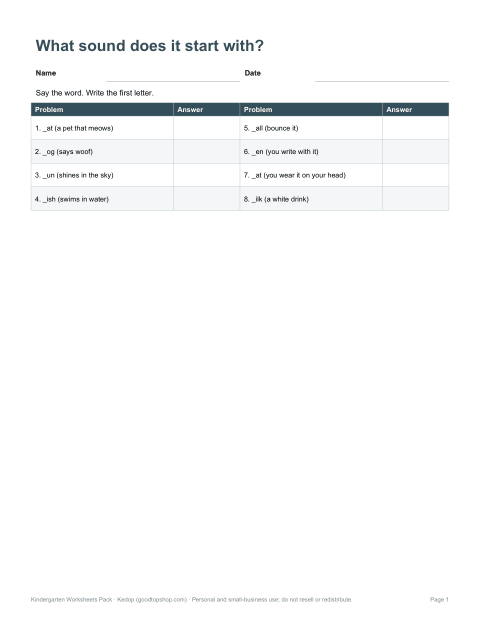
Printable kindergarten worksheets with answer keys: count the objects, number tracing 0–20, letter matching, beginning sounds, shapes, patterns, sight words, picture addition and a skills checklist.
- Count the objects 1 (PDF)
- Count the objects 2 (PDF)
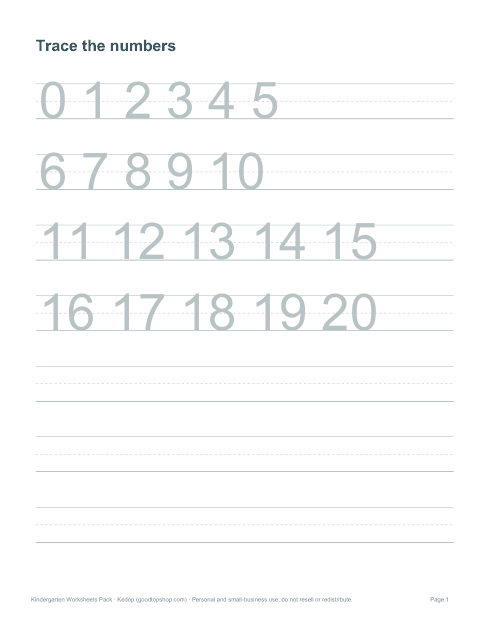
- Number tracing 0–20 (PDF)
- + 7 more
$6.00 USD, one-time 10 files · about $0.60 each
- Instant download
- 7-day refund
- Secure checkout by Stripe
7-day money-back guarantee. Full refund within 7 days of purchase, even after you download.
Free sample: Count The Objects 1 (PDF, 99 KB)
Kindergarten Worksheets Pack
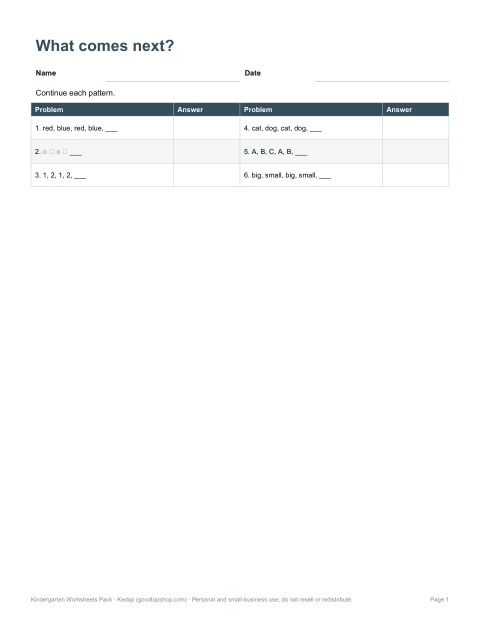
Printable kindergarten worksheets with answer keys: count the objects, number tracing 0–20, letter matching, beginning sounds, shapes, patterns, sight words, picture addition and a skills checklist.
- Count the objects 1 (PDF)
- Count the objects 2 (PDF)
- Number tracing 0–20 (PDF)
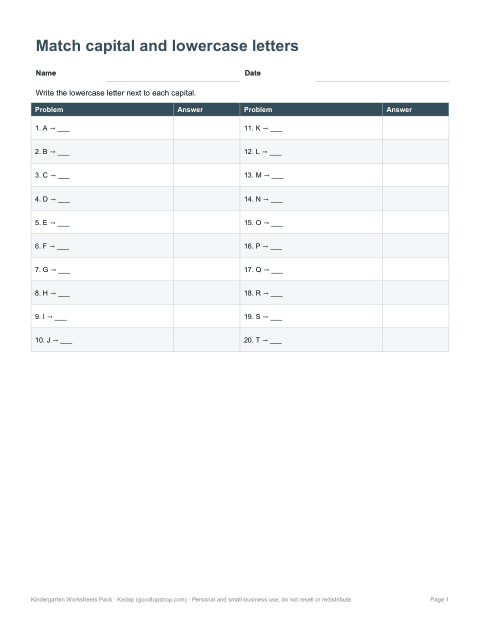
- Letter matching (PDF, DOCX)
- Beginning sounds (PDF, DOCX)
- Patterns (PDF, DOCX)
- Shapes (PDF)
- Sight words (PDF/DOCX)
- Addition to 10 (PDF, DOCX)
- Skills checklist (XLSX/PDF)
Formats: PDF, DOCX. Instant download after payment (link valid 72 hours, up to 5 downloads). AI-assisted: the templates were drafted with AI help and reviewed and laid out before publishing.
$6.00 USD, one-time 10 files · about $0.60 each
- Instant download
- 7-day refund
- Secure checkout by Stripe
7-day money-back guarantee. Full refund within 7 days of purchase, even after you download.
Free sample: Count The Objects 1 (PDF, 99 KB)
Full refund within 7 days — see the refund policy and license.
Free printables
Single sheets you can print right now, no sign-up. The full pack adds every sheet in one download plus the editable files.
 Count and Write Numbers Worksheet1 page · free PDF
 Count the Objects Worksheet1 page · free PDF
 Number Tracing 0-20 Worksheet1 page · free PDF
 Printable Letter Matching Worksheet2 pages · free PDF
 Beginning Sounds Worksheet for Kindergarten2 pages · free PDF
 Printable Kindergarten Patterns Worksheet2 pages · free PDF
 Printable Shapes Worksheet for Kindergarten1 page · free PDF
 Printable Kindergarten Sight Words Worksheet1 page · free PDF
Skills covered
| Area | Worksheets |
|---|---|
| Counting | Count the objects (1–10), count and write (to 20), more or less |
| Numbers | Trace and write 0–20, number order, before and after |
| Letters | Capital and lowercase matching, find the letter |
| Phonics | Beginning sounds, rhyming pairs |
| Sight words | Read, trace and write 20 common sight words |
| Shapes | Name and count circles, squares, triangles, rectangles |
| Patterns | Complete AB and ABC patterns |
| Early addition | Add with pictures to 10 |
How to use kindergarten worksheets well
- Keep sessions short: 5–15 minutes is plenty for most five-year-olds.
- Talk through each page — say the numbers and sounds aloud.
- Use real objects alongside worksheets: blocks, buttons, snacks to count.
- Praise effort and celebrate small wins with a sticker.
- Stop while it is still fun; learning sticks better when children enjoy it.
- Revisit skills over several weeks rather than finishing a whole pack at once.
What children typically learn in kindergarten
By the end of kindergarten many children can count to 100 by ones and tens, count objects to 20, write numbers to 20, recognise basic shapes, and add and subtract within 10 using objects or drawings. In literacy, they learn letter names and sounds, read common sight words, blend simple CVC words and write some letters and words. Every child develops at their own pace; these worksheets support whatever stage your child is at.
Counting and number sense
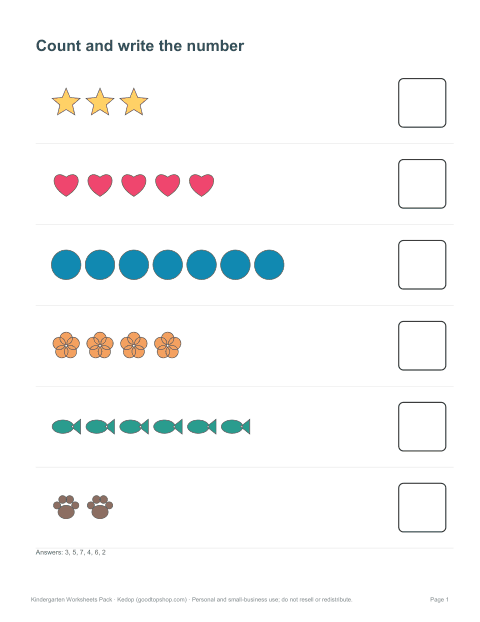
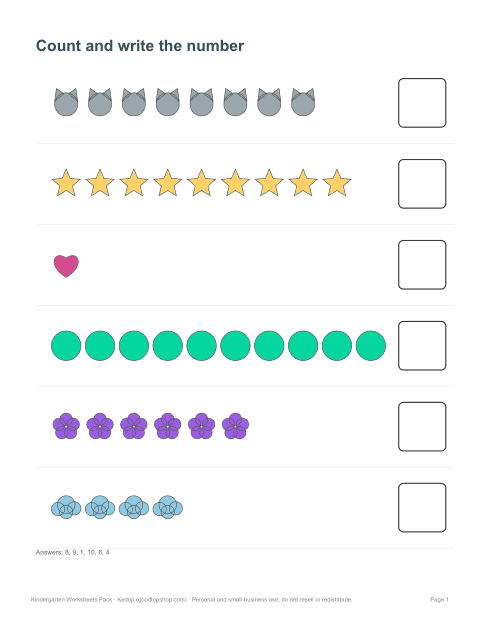
Counting well means more than reciting numbers: children learn to touch each object once, know that the last number said is how many there are, and see that the count doesn’t change when objects are moved. The counting pages ask children to count pictures and write the number in the box, while number-order pages build understanding of before, after and between.
Sight words
Sight words are common words children learn to recognise instantly, such as the, and, see, can, like and my. The pack includes twenty of the most frequent early sight words with read, trace and write practice, plus a flashcard sheet for quick daily review.
Worked example
A parent spends ten minutes after breakfast on a counting page: their child counts three stars, five hearts and seven circles, writing each number in the box. They check with the answer key, then count real spoons and cups at the table to extend the activity. The next day they try a pattern page, continuing red–blue–red–blue with crayons.
Using the skills checklist
The checklist lists key kindergarten skills with space to date when a child can do each one confidently. It helps parents see progress over the year and gives teachers a quick record for conferences.
Making worksheets hands-on
Worksheets work best alongside play. After a counting page, count stairs, steps or toys; after a shapes page, go on a shape hunt around the house; after a pattern page, make patterns with blocks or beads. Laminating a page or slipping it into a plastic sleeve lets children use a dry-wipe marker and practise the same page several times.
Formats
Print-ready PDF worksheets with answer keys (US Letter; A4 with “Fit to page”), Word versions of selected pages and an Excel skills checklist.
Frequently asked questions
What should kindergartners practise?
Counting, number writing, letter names and sounds, sight words, shapes and patterns.
How long should worksheet time be?
About 5–15 minutes at a time.
What if my child finds a page too hard?
Stop, go back to an easier page or use real objects, and try again another day.
Do the worksheets include answers?
Yes, answer keys are included.
Are these suitable for preschool?
Many pages suit older preschoolers; start with counting to 10 and shapes.
Was AI used to create the worksheets?
Worksheets were generated by script and instructions drafted with AI assistance, then reviewed before publishing.